Tuesday, December 13, 2022
ChatGPT, Round Two
Sunday, December 11, 2022
Initial Excursions with ChatGPT
Like many people, I found myself caught up this past week testing out ChatGPT, the new automated chat agent released by OpenAI. It seems like many people across the Internet are using it to test out its functioning in the kind of work they do, whether they are writers, programmers, or my fellow informatics researchers.
Naturally, I tested ChatGPT doing what I enjoy most, namely teaching. My first test was to enter the learning objectives for my well-known introductory biomedical and health informatics course, aka, 10x10 ("ten by ten"). Being the academic that I am, I was also curious what ChatGPT might report for my contributions to the informatics field. The transcript of my interaction is provided below, but first some commentary.
ChatGPT did a much better job with my learning objectives than its report of my accomplishments in informatics. In fact, it got quite a bit wrong about my own work. For example, it reported me as Editor of Journal of the American Medical Informatics Association (JAMIA) and Journal of Medical Internet Research ( JMIR), something my colleagues Sue Bakken and Gunther Eysenbach might dispute. It also gave erroneous information about books that I "authored." While I have edited and authored my textbook Health Informatics: Practical Guide, authored my textbook on information retrieval, and contributed chapters to many other books, I have no involvement whatsoever in the books listed by ChatGPT, Introduction to Health Informatics or Essentials of Health Information Systems and Technology. ChatGPT also listed first among my accomplishments in the field, "work on the development and implementation of EHRs." While I teach a great deal about the electronic health records (EHRs), it would be a stretch to say I am involved in their development and implementation. Clearly ChapGPT is an inferior alternative to Googling oneself.
For the learning objectives, ChatGPT did a little better, and gave reasonable, if incomplete, discussions on the topics in each. It still got some facts wrong, and also omitted what I might consider important details one might want to see in a succinct summary. Perhaps more importantly, ChatGPT provided no citations for what it said, which could allow a learner to check the interpretation or pursue more detail about the topic. I suppose the good news is that one still would do better to get more exhaustive text, figures, and citations covered in the 10x10 course (samples of which can be viewed at my site, informatics.health).
These are obviously early days for tools such as ChatGPT, and no doubt they will improve over time. But just as machine learning algorithms are not quite ready to replace human clinicians, they also are not quite ready to overtake other human tasks, such as teaching, at least not yet.
ChatGPT Transcript - December 10, 2022 (my text entry in italics)
Define biomedical and health informatics, the terms related to it, and its role in health, healthcare, public health, and biomedical research
Biomedical and health informatics is a field that focuses on the use of technology and information to improve the delivery of healthcare, public health, and biomedical research. It is an interdisciplinary field that combines computer science, data science, and healthcare to develop and use information systems and technology to manage, analyze, and interpret health-related data.
Some of the terms related to this field include electronic health records (EHRs), health information technology (HIT), health information management (HIM), and health informatics. These terms all refer to different aspects of using information and technology in the healthcare and public health sectors.
The role of biomedical and health informatics in healthcare is to improve the efficiency and effectiveness of care delivery by using technology and information systems to manage and analyze health-related data. This can include the use of EHRs to manage patient records, the use of HIT to monitor and manage the health of patients remotely, and the use of HIM to ensure the quality and security of health information.
In public health, biomedical and health informatics can be used to monitor and analyze population-level health data to identify trends and patterns, and to develop interventions and policies to improve the health of the population.
In biomedical research, this field can be used to manage and analyze large amounts of data from clinical trials, genetic studies, and other research to advance our understanding of health and disease.
Overall, the goal of biomedical and health informatics is to use technology and information to improve the quality, efficiency, and accessibility of healthcare, public health, and biomedical research.
Describe the major historical events of biomedical and health informatics
The field of biomedical and health informatics has a long and rich history, with many important events that have shaped its development. Some of the major historical events in this field include:
- The development of electronic medical records (EMRs) in the 1950s, which marked the beginning of the use of computers in healthcare to store and manage patient information.
- The establishment of the National Library of Medicine (NLM) in the United States in 1956, which became a major repository for health-related information and a driving force in the development of health informatics.
- The creation of the first Health Information Management (HIM) program at the University of Minnesota in 1967, which marked the beginning of formal education and training in health informatics.
- The development of the first clinical decision support system (CDSS) in the 1970s, which used computers to assist doctors in making diagnostic and treatment decisions.
- The introduction of the first personal health record (PHR) in the 1980s, which allowed patients to manage their own health information and access it from any location.
- The widespread adoption of the internet in the 1990s, which facilitated the sharing and dissemination of health-related information and the development of online health communities.
- The passage of the Health Insurance Portability and Accountability Act (HIPAA) in 1996, which established national standards for the privacy and security of health information.
- The growth of mobile health (mHealth) technologies in the 2000s, which enabled the use of smartphones and other devices to monitor and manage health-related information.
Overall, these and other historical events have played a significant role in the development and evolution of biomedical and health informatics as a field, and have had a profound impact on the way healthcare is delivered and research is conducted.
Discuss the major problems in healthcare motivating use of biomedical and health informatics
There are many challenges and problems facing the healthcare industry today that are motivating the use of biomedical and health informatics. Some of the major problems in healthcare that are driving the use of this field include:
- The increasing cost of healthcare: Healthcare costs are rising rapidly, and many people are struggling to afford the care they need. Biomedical and health informatics can help to reduce these costs by using technology and data analysis to improve the efficiency and effectiveness of care delivery.
- The growing burden of chronic diseases: Chronic diseases, such as diabetes, heart disease, and cancer, are becoming more prevalent and are a major cause of morbidity and mortality. Biomedical and health informatics can be used to monitor and manage these conditions, and to identify and intervene early to prevent their progression.
- The shortage of healthcare workers: There is a shortage of healthcare workers in many parts of the world, which is putting a strain on the healthcare system and making it difficult for people to access care. Biomedical and health informatics can help to alleviate this shortage by enabling healthcare workers to work more efficiently and by supporting remote care delivery.
- The need for better population health management: Many public health challenges, such as obesity, substance abuse, and infectious diseases, require a population-level approach to prevention and management. Biomedical and health informatics can be used to monitor and analyze population-level health data, and to develop and implement interventions to improve the health of the population.
- The need for better data management and analysis: The healthcare industry generates vast amounts of data, but much of it is unstructured and difficult to manage and analyze. Biomedical and health informatics can help to organize and analyze this data to extract valuable insights and inform decision-making.
Overall, the major problems in healthcare are driving the use of biomedical and health informatics to improve the quality, efficiency, and accessibility of healthcare and to address some of the most pressing challenges facing the healthcare industry.
Compare and contrast the roles of various individuals in the health information technology workforce
The health information technology (HIT) workforce includes a wide range of individuals with different roles and responsibilities. Some of the major roles in the HIT workforce include:
- Health information managers (HIMs): HIMs are responsible for the management and analysis of health-related data, including the design and implementation of health information systems and the development and maintenance of electronic health records (EHRs).
- Health information technologists (HITs): HITs are responsible for the technical aspects of health information systems, including the design, development, and maintenance of software and hardware systems used in healthcare.
- Clinical informaticists: Clinical informaticists are healthcare professionals with expertise in both medicine and health informatics. They use their knowledge of both fields to improve the quality and safety of care delivery, and to support the use of health information technology in clinical settings.
- Health information exchange (HIE) coordinators: HIE coordinators are responsible for facilitating the exchange of health-related information between different healthcare organizations and systems. This includes ensuring the interoperability of different systems, and the security and privacy of health information.
- Chief information officers (CIOs): CIOs are responsible for the overall management of information technology in healthcare organizations, including the development and implementation of information technology strategies and the supervision of IT staff.
Overall, the roles in the HIT workforce are diverse and varied, and individuals in these roles work together to support the use of health information technology in healthcare and public health.
Find and access the major sources of information for biomedical and health informatics in the scientific literature and on the World Wide Web
There are many sources of information for biomedical and health informatics in the scientific literature and on the World Wide Web. Some of the major sources of information for this field include:
- PubMed: PubMed is a free database of biomedical literature maintained by the National Institutes of Health (NIH) in the United States. It contains millions of abstracts and full-text articles from scientific journals, and is a valuable resource for researchers and practitioners in biomedical and health informatics.
- IEEE Xplore Digital Library: The IEEE Xplore Digital Library is a comprehensive collection of technical literature in electrical engineering, computer science, and related fields. It contains many articles and conference proceedings on topics related to biomedical and health informatics, and is a valuable source of information for researchers in this field.
- Health Information and Libraries Journal: The Health Information and Libraries Journal (HILJ) is a peer-reviewed journal published by the Health Libraries Group of the Chartered Institute of Library and Information Professionals (CILIP) in the United Kingdom. It covers a wide range of topics related to health information and health informatics, and is a valuable source of information for librarians and other professionals working in this field.
- Journal of the American Medical Informatics Association (JAMIA): JAMIA is a peer-reviewed journal published by the American Medical Informatics Association (AMIA). It covers a wide range of topics related to health informatics, including the use of technology and information to improve the delivery of healthcare and public health.
- Health IT Buzz: Health IT Buzz is a blog maintained by the Office of the National Coordinator for Health Information Technology (ONC) in the United States. It provides news and updates on health information technology and health informatics, and is a valuable source of information for those interested in this field.
Overall, these and other sources of information are valuable for researchers and practitioners in biomedical and health informatics, and provide a wealth of information on the latest developments and trends in this field.
What are the contributions of William Hersh to informatics?
William Hersh is a well-known figure in the field of informatics. He is a professor and the chair of the Department of Medical Informatics & Clinical Epidemiology at the Oregon Health & Science University School of Medicine.
Some of Hersh's notable contributions to the field of informatics include his work on the development and implementation of electronic health records (EHRs), the use of natural language processing for clinical text analysis, and the integration of clinical research data with EHRs. He has also contributed to the development of informatics curricula and has written extensively on the subject.
Hersh is the author of several books on informatics, including "Introduction to Health Informatics" and "Essentials of Health Information Systems and Technology". He is also the editor-in-chief of the Journal of the American Medical Informatics Association and the Journal of Medical Internet Research.
Overall, Hersh has made many important contributions to the field of informatics, including his work on the development and implementation of EHRs, the use of natural language processing for clinical text analysis, and the integration of clinical research data with EHRs.
Wednesday, October 12, 2022
The Most Profound Event in My Informatics Career? Unquestionably the HITECH Act
I recently took part in a small workshop exploring the benefits and challenges for artificial intelligence in medicine. Many of the participants were innovative medical educators, and most of them were still practicing clinical medicine. Although the workshop covered a broad range of topics, one theme stood out to me, perhaps because of my role as an academic informatician. In a nutshell, when we arrived at the topic of implementing AI systems in clinical practice, many laments were expressed about their impact on clinicians and insuring that the use of AI "cannot be as awful as the EHR."
As one who has been working in biomedical and health informatics for over three decades, this discussion about impact on practice and the experience of the electronic health record (EHR) drove home that unquestionably the most profound event in informatics during my entire career has been the the Health Information Technology for Economic and Clinical Health (HITECH) Act. Our field was changed substantially with the passage of the HITECH Act as part of the American Recovery and Reinvestment Act (ARRA) in 2009, leading our present world to be substantially different from the world before it. I also find that many who lament about the negative impacts of the EHR on healthcare are not aware of the history of HITECH.
Those of us who have been around long enough can remember informatics before HITECH. While EHRs had been adopted by many healthcare organizations, including my own, overall use was modest. We were also encouraged, especially in the decade of the 2000s before HITECH, by the growing amount of research published showing that the EHR and associated clinical decision support functionality led to error reduction, cost savings, and improved outcomes. Indeed, a systematic review in 2006 summarized the mostly positive studies, although noting they mostly came from "health IT exemplar" institutions [1]. An updated review in 2009 found similar results [2]. My own view at the time was captured from my participation in a panel on the National Public Radio (NPR) show, Talk of the Nation - Science Friday, in 2005.
Another commentary published in 2010 noted that four "tribes" of healthcare improvement - focused on quality improvement, payment reform , consumer engagement, and health IT - were coalescing in the run-up to health care reform under President Barack Obama, for which HITECH was described by some as a "down payment" [3]. And the pre-HITECH enthusiasm all reached a boil when the ARRA legislation included the HITECH Act and its $30+ billion for incentives for EHR adoption [4].
Here is how I concluded a post in this blog from early 2010 highlighting the details of the HITECH Act:
This is a defining moment for the informatics field. Never before has such money and attention been lavished on it. HITECH provides a clear challenge for the field to 'get it right.' It will be interesting to look back on this time in the years ahead and see what worked and did not work. Whatever does happen, it is clear that informatics lives in a HITECH world now.
To many in informatics, the HITECH Act may now be a distant event, and some in the field who are younger may not even had yet started working in it. But clearly the informatics world is much different now. Informatics is certainly more prominent in operational healthcare settings. Ever increasing numbers of healthcare organizations have anointed clinical leadership devoted to informatics [5].
In retrospect, the widespread EHR adoption of HITECH was carried out too hurriedly, and glossed over some major problems, not the least of which was inadequate adherence to data standards and interoperability. Indeed, it can be said that the health IT components of the 21st Century Cures Act, passed with a bipartisan majority in 2016, were some necessary corrections to the problems emanating from the HITECH Act [6]. The Cures Rule enshrining SMART on FHIR for interoperability and information blocking prohibitions to facilitate movement of data can be viewed from that perspective.
Whether deserved or not, the informatics community is included in the blame for the facts that EHRs slow clinicians down [7, 8], fill the record with questionable and duplicative information [9], and contribute to clinician burnout [10, 11]. The informatics field should accept part of the blame but must also be part of the solution. Actions such as the AMIA-led 25x5 initiative to reduce the burden of EHR documentation to 25% of its current level within five years are important. I also believe there are technologies that will improve the capture of data and clinical thought processes into the EHR, such as voice recognition and reworking of the user interface to facilitate care rather than just documenting it.
Clearly the HITECH Act was the most profound event of our field in modern times. The informatics world before and after HITECH is very different, for better or worse. Ever the informatics optimist, there is great opportunity to improve the use of EHR and other systems to deliver modern healthcare. I am confident we will rise to the challenge.
References
1. Chaudhry, B., Wang, J., Wu, S., Maglione, M., Mojica, W., Roth, E., Morton, S.C., Shekelle, P.G., 2006. Systematic review: impact of health information technology on quality, efficiency, and costs of medical care. Ann Intern Med 144, 742–752.
2. Goldzweig, C.L., Towfigh, A., Maglione, M., Shekelle, P.G., 2009. Costs and benefits of health information technology: new trends from the literature. Health Aff (Millwood) 28, w282-293.
3. McKethan, A., Brammer, C., 2010. Uniting the tribes of health system improvement. Am J Manag Care 16, SP13-18.
4. Blumenthal, D., 2011. Implementation of the federal health information technology initiative. N Engl J Med 365, 2426–2431.
5. Kannry, J., Sengstack, P., Thyvalikakath, T.P., Poikonen, J., Middleton, B., Payne, T., Lehmann, C.U., 2016. The Chief Clinical Informatics Officer (CCIO): AMIA Task Force Report on CCIO Knowledge, Education, and Skillset Requirements. Appl Clin Inform 7, 143–176.
6. Kesselheim, A.S., Avorn, J., 2017. New “21st Century Cures” Legislation: Speed and Ease vs Science. JAMA 317, 581–582.
7. Tutty, M.A., Carlasare, L.E., Lloyd, S., Sinsky, C.A., 2019. The complex case of EHRs: examining the factors impacting the EHR user experience. J Am Med Inform Assoc 26, 673–677.
8. Zheng, K., Ratwani, R.M., Adler-Milstein, J., 2020. Studying Workflow and Workarounds in Electronic Health Record-Supported Work to Improve Health System Performance. Ann Intern Med 172, S116–S122.
9. Steinkamp, J., Kantrowitz, J.J., Airan-Javia, S., 2022. Prevalence and Sources of Duplicate Information in the Electronic Medical Record. JAMA Netw Open 5, e2233348.
10. Gardner, R.L., Cooper, E., Haskell, J., Harris, D.A., Poplau, S., Kroth, P.J., Linzer, M., 2019. Physician stress and burnout: the impact of health information technology. J Am Med Inform Assoc 26, 106–114.
11. Murthy, V., 2022. Health Worker Burnout — Current Priorities of the U.S. Surgeon General [WWW Document]. https://www.hhs.gov/surgeongeneral/priorities/health-worker-burnout.
Sunday, September 18, 2022
A New Pathway For My Career in Biomedical and Health Informatics
This year, 2022, marks a quarter-century of my leadership of academic informatics at Oregon Health & Science University (OHSU). I have served for 19 years as the one and only Chair of the Department of Medical Informatics & Clinical Epidemiology (DMICE) in the OHSU School of Medicine. I served six years before that as Head of its predecessor free-standing Division of Medical Informatics & Outcomes Research, which was established in 1997.
I now plan to step down as Chair of DMICE while continuing at OHSU as a Professor in DMICE, focusing my activities on research, education, writing, and mentoring. I will support the new Chair and prioritize the continued success of the department.
I am pleased to hand off the department at a time when it is doing well academically and financially. The faculty are productive and well-funded in their research, and our educational programs continue to attract strong enrollment and prepare students for diverse careers in our field.
My own research and educational activities are also productive and well-funded. I plan to continue my research in applying information retrieval (IR, also known as search) methods to tasks such as patient cohort discovery though data from the electronic health record (EHR) for which I am funded with an R01 grant from the National Library of Medicine. I also intend to continue working in the evaluation of machine learning for clinical applications, mainly focused on diagnosis of rare diseases through EHR data.
I will also continue teaching both in the OHSU Biomedical Informatics Graduate Program as well as in external collaborations, such as with the American Medical Informatics Association (AMIA) in the 10x10 ("ten by ten") program and the Clinical Informatics Board Review Course (CIBRC). I will also continue existing and new National Institutes of Health (NIH)-funded educational activities, including our recently renewed NLM T15 Training Grant, a new NLM R25 establishing a new college summer internship for students historically underrepresented in our field, the Data Science Initiative for Africa in collaboration with the University of Cape Town, and the new Bridge2AI Program.
Saturday, August 13, 2022
Arrival of 8th Edition of Health Informatics: Practical Guide
I am pleased to announce publication of the 8th Edition of Health Informatics: Practical Guide. The goal of this textbook is to provide a comprehensive introduction to the field of health informatics (also known as biomedical and health informatics or just plain informatics) for students. The book can also serve as a current update for those who are already practitioners. As in any professional field, there is a knowledge base and history of scientific progress in informatics that informs current practice, and this book aims to impart that.
The impetus for this book came from Robert Hoyt, MD, who served as its lead Editor for the first seven editions. In preparing the seventh edition, Dr. Hoyt engaged me as a Co-Editor, with the plan for me to become the Editor of the 8th edition. Dr. Hoyt and his wife Ann Yoshihashi, MD have been great mentors in the process of putting a book like this together. As with the previous editions, the book is available in print and eBook formats.
This book is aimed at those who wish to learn about the field of biomedical and health informatics. The content is almost completely redone from previous editions and roughly follows a course I have taught for three decades to about 5000 students in a graduate course at Oregon Health & Science University, the American Medical Informatics Association 10x10 ("ten by ten") program, and a number of other derivative courses for medical students, graduate students, and health IT professionals. I have engaged a variety of other authors for many of the chapters to give additional expertise and perspective. This edition of the book is completely rewritten from earlier editions, reflecting the profound change and progress in the field.
I have established a Web site for the book, which has links to purchasing the book in print and eBook formats from the publisher, Lulu.com. The book is also available from Amazon.com in print and Kindle formats. The Web site also contains sample chapters in PDF and EPUB formats, and will maintain an Errata page of errors discovered in the book.
The chapters of the book include:
- Introduction to Biomedical and Health Informatics
- A Short History of Biomedical and Health Informatics
- Computing Concepts for Biomedicine and Health
- Electronic Health Records
- Standards and Interoperability
- Data Science and Artificial Intelligence
- Clinical Decision Support
- Natural Language Processing
- The Role of Health Informatics in Safety, Quality, and Value
- Health Information Exchange (HIE)
- EHR System Selection and Implementation
- Telemedicine and Telehealth
- Privacy and Security
- Information Retrieval (Search)
- Clinical Research Informatics
- Translational Bioinformatics
- Nursing Informatics
- Consumer Health Informatics
- Public Health Informatics
- Evidence-Based Medicine
- Imaging Informatics
- Ethical Issues in Health Informatics
- Human-Computer Interaction
Friday, July 1, 2022
Reflections on Publishing a Negative Study
Wednesday, June 29, 2022
2022 Update of Informatics.Health
I am pleased to announce an update of my Web site that provides an introductory overview of biomedical and health informatics. Entitled, What is Biomedical & Health Informatics?, I created this site two decades ago to provide an answer to that question I used to be asked (less so in modern times). I still maintain and keep the site up to date both to continue to provide an overview of the field as well as demonstrate a portfolio of some of the learning technology we use in our virtual courses in the Biomedical Informatics Graduate Program at Oregon Health & Science University (OHSU).
In recent years I was able to secure the domain name, Informatics.Health.
With the 2022 updating of my larger course that is offered in the American Medical Informatics Association (AMIA) 10x10 ("ten by ten") program, I have now updated the content of the WhatIs site. The main part of the site is the 11 lecture segments on the following topics:
- What is Biomedical and Health Informatics? (1) (24:32)
- What is Biomedical and Health Informatics? (2) (18:49)
- A Short History of Biomedical and Health Informatics (22:30)
- Resources for Field: Organizations, Information, Education (25:29)
- Clinical Data (15:08)
- Examples of the Electronic Health Record (EHR) (24:56)
- Data Science and Artificial Intelligence (1) (14:15)
- Data Science and Artificial Intelligence (2) (22:07)
- Information Retrieval (Search) (23:18)
- Information Retrieval Content (29:09)
The lectures can be viewed on just about any Web platform, and work fine on mobile devices. The site also contains links to books, articles, organizations, and educational Web sites. The materials on the site are freely available and have been used by many educators and others.
Wednesday, April 6, 2022
3000 by 2022 - A New Milestone for the 10x10 Course
One of the most enjoyable and impactful activities of my career has been the 10x10 ("ten by ten") course, which is an online introductory course in biomedical and health informatics that I teach in partnership with the American Medical Informatics Association (AMIA). The course recently reached a new milestone, surpassing 3000 people completing the course since its inception in 2005. My course from Oregon Health & Science University (OHSU) was the original and is the largest course of the AMIA 10x10 Program.
The OHSU 10x10 course provides an up-to-date detailed introductory overview of biomedical and health informatics. The content delivery is online, followed by an optional in-person session, typically at an AMIA meeting, at its conclusion. About 10-15% of those completing the course take the optional final exam and pursue further study in the field, usually but not exclusively at OHSU.
Friday, March 25, 2022
Clinical Informatics Subspecialty Practice Pathway Extended for Three Additional Years
A three-year extension to the Practice Pathway of board certification eligibility for the clinical informatics (CI) subspecialty has been approved by the American Board of Medical Specialties (ABMS) for the American Board of Preventive Medicine (ABPM). This is the second extension of the so-called "grandfathering" pathway that now allows physicians with a primary boarded specialty to achieve board eligibility without formal fellowship training through 2025. This means that physicians who desire to become board-certified in CI will be able to qualify to sit for the board examination by time working in the field or completing "non-traditional" training, the latter which may include a master's degree from a "24 month Masters or PhD program in Biomedical Informatics, Health Sciences Informatics, Clinical Informatics, or a related subject from a university/college in the US and Canada, deemed acceptable by ABPM (e.g. NLM university-based Biomedical Informatics Training)," such as the online Master of Science Program at Oregon Health & Science University (OHSU).
The CI field has expressed mixed feelings on this extension. In particular, a group of CI fellowship Program Directors published a letter in the journal Applied Clinical Informatics (ACI) opposing the extension, noting that the time for grandfathering has passed, and extending the practice pathway will adversely impact pursuit of fellowships.[1] I rebutted this letter, arguing that the field must find alternatives to two-year in-place fellowships to allow broader entry into the field.[2] In particular, a two-year in-place fellowship may place undue burdens on those who wish to become board-certified in CI long after they completed their primary training and would be unable to uproot from job, family, and/or other obligations.
Here are some snippets from my ACI letter arguing for alternatives to in-place fellowships:
I agree that we have passed the point where the Practice Pathway should allow physicians to become board-certified with essentially no formal training. However, I argue instead for this approach to be transformed into a method by where those who are unable to halt careers, salary, and family to pursue a pathway to certification that is mostly virtual and asynchronous yet still rigorous and supervised. Ironically, the pandemic has taught us that CI practice and education can be carried out in a mostly virtual format.
The in-place model for fellowship training made sense in the 20th century model of career development, where one completed education and training in their chosen profession and then entered the workforce for their career. In the 21st century, however, many professionals, especially in knowledge careers, change career pathways long after their primary education and training experience.
I oppose CI fellowships being completely remote, but it would be novel and innovative if there were some sort of hybrid training pathway, with fellows connected to an institution that could offer courses and allow supervised, mentored training experiences in healthcare organizations. Fellows would participate in a mostly remote way, but also have periodic in-person experiences, including stints that might be for several weeks or more and would involve direct interaction with faculty and colleagues. The field of Hospice and Palliative Medicine developed such an approach prior to the COVID-19 pandemic. Even CI somewhat emulates this approach now, as a half-dozen CI fellowships make use of online didactic courses from OHSU.
I applaud that for now the Practice Pathway will still allow those to pursue board certification. Hopefully the CI field can transition to a training process beyond the Practice Pathway that allows entry into the field without an in-place fellowship. As informaticians, we should be at the forefront of pioneering this approach in graduate medical education.
What are eligibility requirements for the CI subspecialty? They are essentially unchanged from the last time I posted about them in this blog in 2019, with the exception that the "grandfathering" pathway is now available through 2025.
References
Friday, March 11, 2022
Receding of the Pandemic: Will the Third Time Be the Charm?
Tuesday, January 11, 2022
Considerations and Transitions for Narrating Lecture Slides
For over two decades, a significant portion of my teaching at Oregon Health & Science University (OHSU) has been online, and one of the main modalities I have used is narrated lectures, in particular, voice-over-Powerpoint slides. I know that many bemoan the use of Powerpoint for any presentations, including teaching. However, I find slides a very useful way to organize information, utilize simple graphics, and develop a big picture for the knowledge I aim to convey. As I use my teaching slides for other purposes, such as giving talks, another critical need for me is to maintain the source Powerpoint files.
This makes my choice of tool(s) to create voice-over-Powerpoint files critically important in my work. Over the years, I have used different tools for doing so. My initial foray used a technology that some Internet long-timers might remember, called RealMedia. Another imperative in the early days, circa 1999, was that the files not be too large so as not to require substantial bandwidth, since those were the early days of broadband Internet, and many people were still connecting, especially from home, via telephone modems.
Another lesson learned in those early days was that learners preferred online lectures to be broken down into 15-20 minute segments. This also made recording easier, as one did not have to record an entire lecture in a single session.
Over time, there was development of new tools. RealMedia eventually fell out of favor with many users and developers, and for a while I used a now-defunct tool from Adobe called Presenter. It used an output format that was very popular for many years, Flash, which was retired a few years ago.
In 2007, I discovered another tool that served me well for a long time, Articulate Presenter. One of its key features was the ability to record a single slide at a time. All of the tools I used before then required the lecture over the whole slide deck to be recorded in a single session. Being able to record slide by slide was useful for several reasons, not the least of which was that most of my updating of curricular content involved incremental update of single slides and not the entire lecture segment. In other words, a small part of a topic might change, and by being able to update individual slides, I could update just those slides than needed it.
Another feature I valued from Articulate Presenter was being able to configure the output with a navigation and notes frame on the left, enabling individuals slides to navigate to specific slides, and for the text in the notes field of the slides to be viewed. The output was generated in Flash when it was in its heyday. and then transitioned to HTML 5 as Flash was being retired.
But there is one big limitation of Articulate Presenter, which is that it only runs on Microsoft Windows. My primary computer when I started using Articulate Presenter was a Windows PC, but in the early 2010s, I was feeling the pull to return to the Macintosh platform that I had moved away from in the mid-1990s. Part of the allure was that Apple itself was transitioning to Intel chips, meaning that Macintosh computers could run Windows and its applications.
I made the transition back to the Mac in 2012, and fairly seamlessly moved my Articulate Presenter work to running Windows on Parallels. But although the solution worked, it was somewhat clunky, and having to launch Windows to do any work in Articulate Presenter required a number of steps. Despite the protestations of myself and many other users (evidenced in their support forums), Articulate never developed a native Mac version of Presenter.
In the last couple years, of course, Apple has transitioned away from Intel chips. This is a good thing for Mac users generally, as the speed and power consumption is remarkable. And while there is supposedly a version of Windows that runs on the ARM chips that Apple is now using, it does not run most native applications, including Articulate Presenter.
Fortunately during this same time, Microsoft has been improving the slide narration capabilities, and one can now easily narrate slide by slide directly in Powerpoint. And then the output can be exported to a standard video format such as MP4 or MOV. In addition, OHSU uses the Echo 360 platform, which allows video files to be posted to a server. While the video output of Powerpoint does not have all the navigation features of Articulate Presenter, the learner can still navigate around the lecture. Echo 360 also offers automated closed-captioning, although it is far from perfect.
This transition will require me to re-record all lectures completely, but many lectures are due for that anyways. In addition, I can record in Powerpoint slide by slide. Using Powerpoint on my Mac is also much less clunky that using Articulate Presenter in Windows on a Mac. It is especially easy when I need to make a small update, such as finding and fixing a typo in a slide, and not having to launch Windows, and then Articulate Presenter.
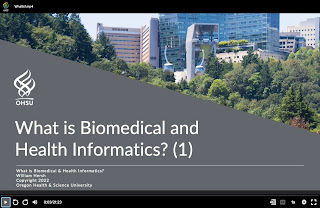
One can see an example of the results of my new approach in the image below from a Web site that I maintain, What is Biomedical and Health Informatics? I have maintained this site for many years, both as a way to introduce the world to my view of the field of informatics and also a showcase for the online learning modalities that our program uses. The site also has a great domain name I was able to snag when .health was made a top-level domain, http://informatics.health/. I have redone the lectures on this site using my new approach.
Certainly a bottom line is that the ease of updating lectures far outweigh the small additional features provided by Articulate Presenter. It may seem somewhat ironic that improvements in Microsoft Powerpoint now give me the ability to move on from Microsoft Windows and Articulate Presenter. But I am pleased that I can now can evolve with Apple as it innovates its hardware and software with its new ARM chips.
Friday, December 31, 2021
Annual Reflections at the End of 2021
As is the tradition with this blog, I end each year with a reflective look at the year past and what the future may hold. The year 2021 is not ending quite like I anticipated. At the beginning of the year, there were stirrings of optimism. The new COVID-19 vaccines had been released, and a new approach to political leadership had just been elected in Washington, DC. On January 2nd, I received my first dose of the Pfizer vaccine, followed by a second one three weeks later.
Tuesday, December 21, 2021
From Reading to Writing: Next Steps for Patient Data Exchange and Interoperability
The rationale and implementation for reading data from the electronic health record (EHR) and other clinical sources is relatively simple and straightforward. Especially now enshrined into law in the US by the 21st Century Cures Rule, and standardized by the FHIR application programming interface (API), accessing data for reading by clinicians, patients, and others is here to stay.
Writing data to the EHR or other clinical information systems is a little more complicated. As in all aspects of informatics, the technology part is relatively simple, as activating the API in the reverse direction is not difficult technologically. But writing data into the EHR and other systems raises a number of issues. Earlier this year, the Office of the National Coordinator for Health IT (ONC) convened a workshop to address this topic. The workshop discussed stakeholder knowledge, current usage, potential use cases, and lessons learned on “write-back” API functionality. A report from the workshop was released in November, 2021 and provides excellent insights into the usage and challenges for such technology. Five categories of stakeholders were represented: researcher, technologist, healthcare provider, patient, and financial technologist. (The provider perspective was provided by OHSU faculty Dr. Ben Orwoll.)
- Data from devices, such as wearables and remote monitors
- Questionnaires from patients or care activities
- Results of risk scores and calculators
- Patient input of symptoms or reported outcomes
- Recommendations of clinician decision support
- Annotation or amending of patient notes
- Results or recommendations of machine learning/artificial intelligence algorithms
- Data from transitions of care across orgniazations
- Community sources of data, including social determinants of health
Also identified were a number of technology barriers to writing data back into the EHR:
- Limitations of FHIR standard
- Accuracy and completeness of the data
- Security of data from third-party apps
- Mapping and coding issues for data entering EHR and other systems
- Patient-matching accuracy
- Requirements for manual workflow and/or reconciliation
- Obligations of organization and clinicians for data written back
In addition, the report raised a number of policy, preference, and data use concerns:
- Data ownership and expectations for patients and clinicians
- Compliance with HIPAA and other current laws
- Relationship to designated record set and legal medical record
- Regulation needed to support open APIs and their adoption
- Requirements for future policy
Monday, December 20, 2021
Kudos for the Informatics Professor - 2021 Update
- Chen J, Hersh W, A comparative analysis of system features used in the TREC-COVID information retrieval challenge, Journal of Biomedical Informatics, 2021, 117:103745.
- Roberts K, Alam T, Bedrick S, Demner-Fushman S, Lo S, Soboroff I, Voorhees E, Wang LL, Hersh WR, Searching for answers in a pandemic: an overview of TREC-COVID, Journal of Biomedical Informatics, 2021, 121:103865.
- Koch S, Hersh WR, Bellazzi R, Leong TY, Yedaly M, Al-Shorbaji N. Digital Health during COVID-19: Informatics Dialogue with the World Health Organization. Yearbook of Medical Informatics. 2021, 30(1):13-16.
- Haux R, Ball MJ, Hersh WR, Huesing E, Kimura M, Koch S, Martin-Sanchez F, Otero P. The International Academy of Health Sciences Informatics (IAHSI): 2020 Report. Yearbook of Medical Informatics. 2021, 30(1):8-12.
- Hersh W, Biomedical Informatics, in Kutz M (ed.), Biomedical Engineering Fundamentals, Third Edition, McGraw-Hill, 2021, 31-48.
- Hersh W, Information Retrieval, in Shortliffe EH, Cimino J, Chiang MF (eds.), Biomedical Informatics: Computer Applications in Health Care and Biomedicine, 5th Edition, New York, Springer, 2021, 761-800.
- Hersh W, A Passion and a Calling, in: Kulikowski, C., Mihalas, G., Yacubsohn, Y., Greenes, R., Park, H.-A. (eds.), IMIA History Book. Healthcare Computing & Communications Canada, 2021, 383–386 (described further in an earlier post to this blog).